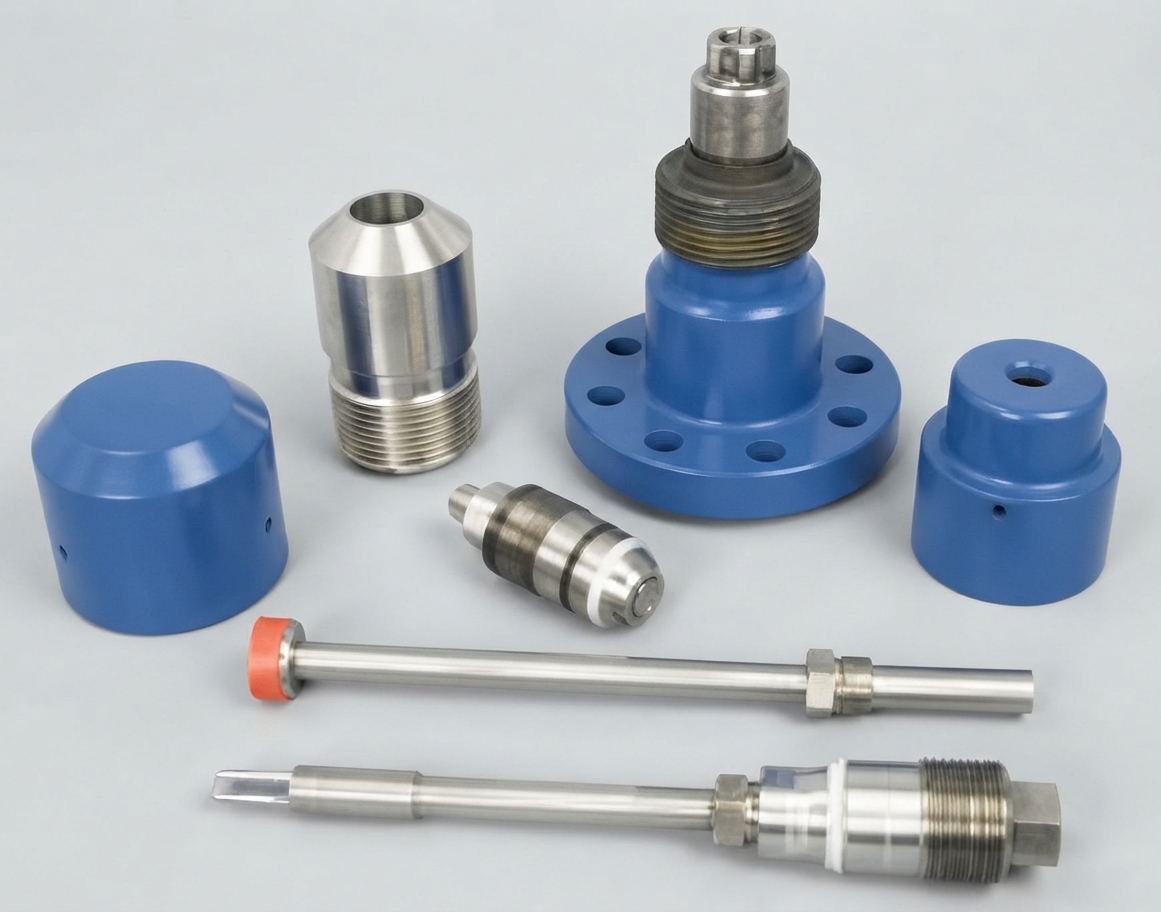
Access Systems
Introduction & Industry Standard
High-Pressure Access Systems are specialized piping arrangements designed to provide internal access to production plant vessels and pipework operating under full process conditions (up to $6000 psi). Widely used in oil and gas production, these systems allow engineers and operators to install, monitor, and retrieve internal monitoring equipment safely without requiring a full plant shutdown or depressurization.
Core Components
A complete high-pressure access system consists of five primary components:
- Access Fitting Body: Permanently attached to the vessel or pipe wall via welding, threading, or flanging (available in standard and low-temperature material specifications complying with NACE MR0175).
- Plug Assembly: The retrievable carrier that screws into the body to seal line pressure. Divided into Solid Plugs (for coupons, sand probes, and bio-probes) and Hollow Plugs (for electrical resistance, linear polarization, and hydrogen probes).
- Protective Cover: Shields external threads and sealing surfaces from environmental damage or mechanical wear (available in heavy-duty pressure-rated or economical non-pressure-rated variants).
- Service Valve: Used to contain line pressure once the plug assembly is removed during retrieval procedures.
- Retrieval Tool: Operates in tandem with the service valve to safely insert or extract the plug assembly under full operational pressure.
System Options: HP™ vs. MH™ Series
Metal Samples / ALSPI offers two primary configurations:
- HP™ System: The generic industry standard design, widely compatible and interchangeable with other major manufacturers.
- MH™ System: A proprietary design featuring advanced enhancements, including coarse ACME plug threads to reduce galling, a quick-stab collet, positive alignment grooves for precise coupon/nozzle orientation, and a metal-to-metal back-up seal to prevent leakage under high temperatures.
Key Applications
- Corrosion & Erosion Monitoring: Deployment of electrical resistance (ER) and linear polarization resistance (LPR) probes, weight-loss coupons, and sand probes.
- Chemical Injection & Sampling: Utilization of side-tee fitting bodies for process fluid sampling, chemical injection quills, and nozzle arrangements.
- Biological & Hydrogen Monitoring: Insertion of specialized bio-probes and hydrogen monitoring sensors.