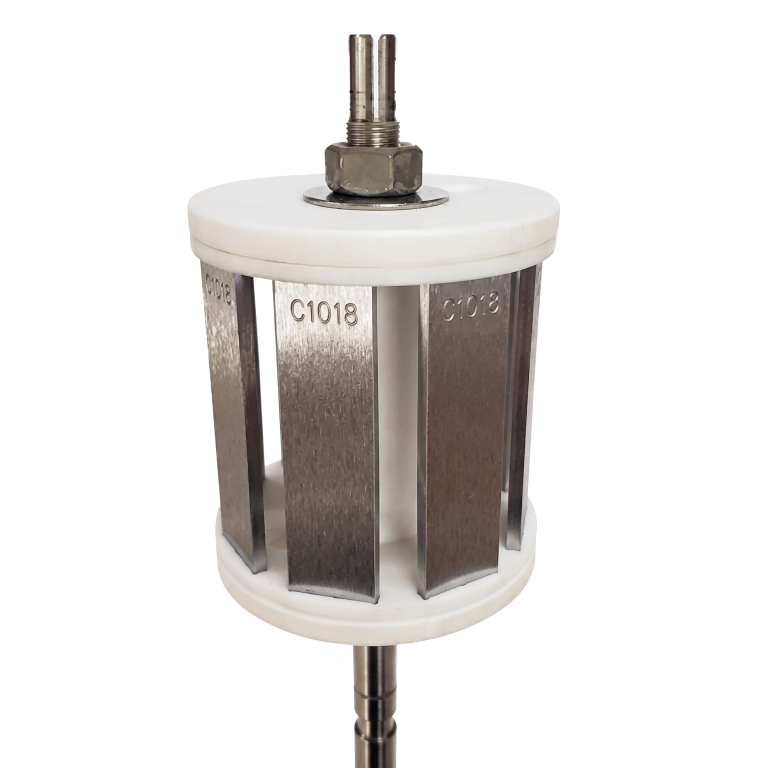
Advanced Corrosion Inhibitor Evaluation under Dynamic Flow Conditions
Simulate Severe Pipeline Hydrodynamics in the Laboratory
The Atmospheric Pressure Rotating Cage System (TF4500) by Metal Samples provides a reliable, cost-effective solution for qualifying and selecting corrosion inhibitors used in oil and gas facilities, transmission pipelines, and refineries. By inducing high shear stress and turbulent flow regimes, the system replicates real-world localized corrosion and pitting dynamics in a controlled benchtop environment.
Fully compliant with industry standards—including ASTM G202, ASTM G184, and ASTM G170—this system enables precise evaluation of inhibitor efficiency, liquid corrosivity, and candidate metal alloys.
Key Features & Benefits
- Standard-Compliant Testing: Built to ASTM G202 specifications, ensuring high repeatability and reproducibility across laboratory evaluations.
High-Capacity Setup: Holds eight flat specimens (75 × 19 × 3 mm) per run, allowing simultaneous testing of replicates for high-confidence data collection.
Variable Dynamic Speeds: Variable rotational speeds up to 1,000 RPM simulate severe flow-induced corrosion and shear stress conditions.
Robust Chemical Compatibility: Wetted components constructed from PTFE, polycarbonate, 316L stainless steel, and high-performance seals ensure long-term durability in corrosive fluid environments.
Complete System Package: Includes the main test assembly, a digital speed controller, and an initial set of 8 test coupons.
Technical Specifications
Measurement Technique: Mass Loss Analysis
Max Operating Temperature: Up to 70°C (158°F)
Rotational Speed: Up to 1,000 RPM
Coupons Supported: 8 flat coupons (Surface Area: 34.14 cm² each, 150 grit finish)
Power Requirements: 100–120 VAC, 1/8 HP, 0.8 A
Wetted Materials: PTFE, Polycarbonate, SS 316L, Rubber Seals
Frequently Asked Questions
The TF4500 is designed for laboratory evaluation and qualification of corrosion inhibitors used in oil and gas production, pipelines, and refineries. By spinning test coupons at high velocities, it simulates turbulent flow and dynamic shear stress conditions to evaluate localized pitting and general corrosion under realistic operating environments.
The system complies with key ASTM standards for laboratory corrosion testing, including:
ASTM G202: Standard Test Method for Using Atmospheric Pressure Rotating Cage
ASTM G184: Standard Practice for Evaluating and Qualifying Oilfield and Refinery Corrosion Inhibitors Using Rotating Cage
ASTM G170: Standard Guide for Evaluating and Qualifying Oilfield and Refinery Corrosion Inhibitors in the Laboratory
The TF4500 holds eight flat coupons per test run. The standard coupon dimensions are 75 mm × 19 mm × 3 mm (with a surface area of 34.14 cm² and a 150 grit surface finish). Running multiple coupons simultaneously allows for easy execution of replicate samples for accurate data statistical analysis.
Rotational Speed: Variable up to 1,000 RPM
Maximum Temperature: Up to 70°C (158°F)
Measurement Method: Mass Loss Analysis
Power Requirements: 100–120 VAC (1Ø, 1/8 HP, 0.8 A)
To withstand corrosive test fluids and inhibitor formulations, all wetted components are constructed from high-performance materials including PTFE, Polycarbonate, 316L Stainless Steel, and Rubber seals.